Unlocking Creativity: Integrating Fantasy Backgrounds Goblin Caves Pack 1 into Your Creative Workflow
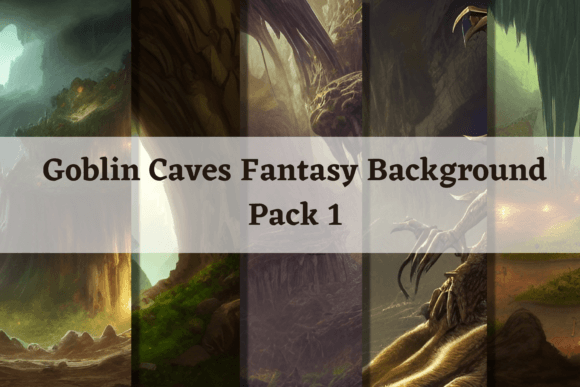
In the world of digital creation, the search for high-quality, thematic assets is often a bottleneck. Fantasy Backgrounds Goblin Caves Pack 1 addresses this directly. It is a set of five whimsical, fantasy background illustrations of goblin caves, each rendered at 1024x1024 pixels at 72 dpi. This pack isn't just a collection of images; it’s a versatile resource designed to be deployed across numerous creative and professional contexts. The key to its value lies not merely in its content but in understanding how it integrates into a broader process, from initial concept to final product.
Understanding the Asset and Its Strategic Place
The pack serves as a foundational visual element. Each JPG image is compatible with any software that recognizes the format—from Adobe Photoshop and Canva to game engines and publishing software—ensuring immediate usability after download. For professionals and hobbyists alike, this eliminates technical friction. The core use cases are broad: book covers, graphic design projects, social media flair, blogs, wallpapers, tabletop gaming materials, greeting cards and invitations, and as inspiration or reference for further illustration. This versatility means the pack can be considered early in the planning phase of many projects.
Think of it as a modular component. During your initial brainstorming or mood board creation, these backgrounds can provide a concrete aesthetic direction. Instead of starting from a blank canvas, you begin with a defined atmosphere—the quirky, shadowy, and whimsical world of a goblin cave. This accelerates the conceptual stage. For a novelist seeking cover art, for a game designer creating encounter maps, or for a marketer designing a campaign for a fantasy product, these images offer a ready-made setting that aligns with a specific fantasy subgenre.
Integration into Project Planning and Execution
The practical implementation of Fantasy Backgrounds Goblin Caves Pack 1 hinges on its role as a flexible asset. Its use can occur at multiple points in a project’s lifecycle.
During the Conceptual and Planning Phase
In the early stages, these images function as a visual anchor. A graphic designer might use one as a temporary background in a mock-up to present a concept to a client, quickly establishing tone before custom illustration begins. A blogger writing about fantasy lore might immediately embed an image to visually break up text and set the thematic mood, enhancing reader engagement without commissioning custom art. This early application saves time and budget, allowing you to validate a creative direction before committing to more expensive or time-intensive resources.
As a Core Component in Active Production
Here, the pack moves from inspiration to integral part of the final output. For independent publishers, one of these backgrounds could become the complete backdrop for a book cover, with title text and author name layered over it. In tabletop gaming, the images might be printed as physical battle maps or used digitally in virtual tabletops like Roll20, directly shaping the player's experience. The 1024x1024 resolution is particularly suited for digital uses like social media posts or blog headers, where it provides ample detail without being overly large for standard web performance. The key is to treat the backgrounds as a base layer. Your additional creative work—typography, character illustrations, game icons, promotional text—interacts with this base, building upon its established mood.
For Post-Production and Long-Term Asset Management
After a project is completed, consider how such a resource fits into your long-term library. Because the images are generic scenes rather than character-specific, their reuse potential is high. A different crop or color adjustment can make the same cave background serve a new purpose in a future project. Organizing these assets alongside your other stock resources—tagging them by theme, color palette, and intended use—ensures they remain a quick-access tool for future workflows. This contributes to consistency across your body of work if you operate within the fantasy niche, and improves overall efficiency.
Practical Workflow Examples and Implementation Tips
To move from theory to practice, let's examine specific workflow scenarios.
For a freelance graphic designer creating a series of social media banners for a fantasy board game launch: The designer could download the pack, select two complementary cave images, and use them as the background for all banner variations. By maintaining the same background across different text and call-to-action overlays, the campaign achieves visual cohesion. The designer’s process is streamlined; they aren’t searching for new backgrounds for each post.
For a small business owner running an online store selling fantasy-themed greeting cards: The owner can use an image from the pack as the full artwork for a "Goblin Birthday" card. Using simple design software, they add a text layer. The entire product creation process—from asset selection to layout to print-ready file—is condensed into a short, efficient task, enabling quick response to market trends or customer requests.
For a content creator or educator producing video tutorials on fantasy art: The backgrounds can serve as reference images during the tutorial, or even as the default background for the video's intro sequence. This adds professional, thematic polish to the content without requiring the creator to generate original background art for every video.
A crucial implementation tip is to always check the final context. While 72 dpi and 1024x1024 pixels are perfect for digital screens, if a project requires high-resolution physical printing (like a large format book cover or poster), you may need to employ the image strategically—perhaps as a central element surrounded by other design—or use image-editing software to subtly enhance its scalability through careful sharpening and blending.
Interacting with Other Tools and Resources
Fantasy Backgrounds Goblin Caves Pack 1 does not exist in isolation. Its effectiveness is amplified by how it combines with other elements in your toolkit.
- Software: Its JPG format ensures it drops seamlessly into layer stacks in Photoshop, Illustrator, or Affinity Designer. It can be a background in PowerPoint for a presentation, or in Word for a quick newsletter layout.
- Other Asset Packs: It can be combined with packs of fantasy characters, icons, or textures. A goblin cave background layered with separate goblin character illustrations creates a more complex scene while maintaining stylistic harmony.
- Creative Methods: It supports iterative design. You can prototype rapidly with these backgrounds, getting stakeholder approval on the general look before investing in custom foreground elements.
This interoperability reduces project risk. You can assemble a compelling visual proof-of-concept using mostly stock assets, securing buy-in or funding, and then later replace components with custom work as needed, while keeping the proven background intact.
Factors Ensuring Smooth Integration
Successful integration depends on a few practical considerations.
Preparation and Organization
Upon downloading, immediately file the images in your structured asset library. Use descriptive filenames or tags (e.g., "goblin-cave-mossy," "goblin-cave-tunnel") to make them searchable later. This simple step prevents the "lost asset" problem that disrupts workflows.
Quality Control and Adaptation
While the provided quality is consistent, your application may require adjustments. Minor color correction to match a brand palette, or cropping to focus on a specific cave detail, can tailor the generic image to your specific need. This lightweight editing is part of the integration process, making the asset truly yours.
Consistency Across Projects
If you work repeatedly within the fantasy genre, using a curated set of backgrounds like this pack across multiple projects builds a recognizable visual signature for your brand or portfolio. This is an outcome often overlooked: asset packs can contribute to long-term brand identity development.
Ultimately, Fantasy Backgrounds Goblin Caves Pack 1 is more than five images. It is a process accelerator. It fits into the early planning stages to solidify vision, into the active production phase as a reliable building block, and into your permanent resource library for ongoing utility. By understanding its role as a versatile, compatible, and thematic component, creators can integrate it smoothly, reducing time spent on asset procurement and increasing time focused on the unique creative layers that define their work. The goblin caves are waiting—not just as a backdrop, but as a springboard for your next project.